
A personal reflection from Dr. Adriana Candeias
Before you read: Today, I am stepping from the boardroom into a more personal space, because the same relational patterns shape both. What follows contains tensions. I invite you to sit with them, disagree, and add your voice. This is not a manifesto. It is a conversation starter.

The Connected Man - Our Mastering Connection course for men who want to build bridges in their life and the lives of others.
I write this with complexity in my heart.
The headlines are full of everything that is "wrong" with men. As a coach dedicated to women's leadership and empowerment, I feel the weight of that frustration. I see the systemic violence and deep-seated disconnection. And I believe our collective anger can be a sacred spark, the fuel we need to set definitive boundaries and say "no" to abuse and control.
But as we stand our sacred ground, we must also ask: Is blaming the abstract category of 'men' truly fixing the systemic problem?
I carry deep appreciation for the men who have inspired my value of freedom and connection. While the problem is indeed the system, the cure must be systemic too.
But systems are made of people. Lasting change requires both collective shifts in culture and individual willingness to evolve. This article speaks to the individual pathway, without denying the urgent need for structural transformation.
We cannot simply wish the men in our lives were different. We must invite those willing to listen to help us build a more human world, one that values care, connection, and nurture-giving relationships.
This is why Mark Archer and I have designed The Connected Man.
The Failure of the Current "Operating System"
Many men operate on a system that prioritises productivity and "stoicism" over authentic human connection. They are often caught between two polarities: the "extremely quiet stoic" or the "fiery, explosive" man.
This system is failing them. And it is failing us all. The human consequences are stark:
A loneliness epidemic: In the 1990s, 55% of men had six or more close friends. Today, that has plummeted to 27%, with 15% of men reporting they have no close friends at all.
The single point of safety: For a significant portion of men, their wife or partner is the only person they feel safe being vulnerable with. This places an unsustainable weight on one relationship.
Relational isolation: Disconnection is not just a social issue. It is a health crisis, impacting inflammation, mortality, and overall longevity.
When a man has no one to talk to except his partner, and that partner is exhausted from carrying that load, everyone loses.

Moving from "The Problem" to "The Change"
We need an upgrade, not a rejection of masculinity, but a deepening of it.
Men need to trade their "masks" for a different kind of strength. The kind that does not need to dominate to be powerful. The kind that does not need to hide to avoid blame.
This starts with two capacities:
Connect to oneself (purpose, emotions, limits).
Connect to others (listen, repair, collaborate).
Connection is not a mystery. It is a skill. And skills can be learned.
A Note on Anger and Invitation
Anger is useful when it sets boundaries. But boundaries are not bridges.
The invitation to change requires a different energy, one of hope, not accusation. Both are valid. Both are needed. This article speaks from the bridge.
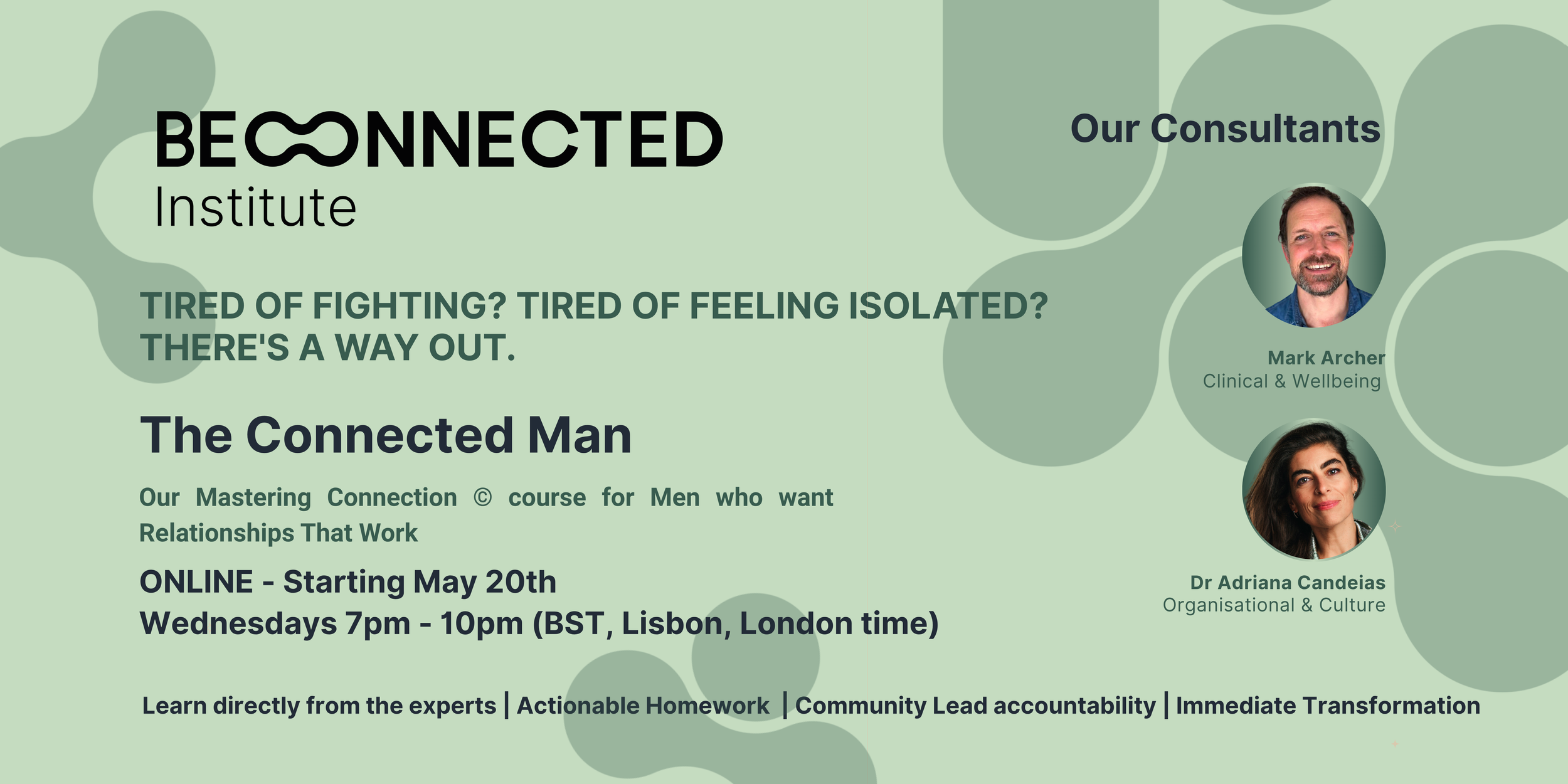
Introducing The Connected Man
After running our flagship Mastering Connection course, we noticed something: men were hungry for a space tailored to their specific relational challenges. Not because the principles of Relational Intelligence (RI) are different for men, but because the social conditioning they must unlearn is unique.
That is why we designed The Connected Man: a 6-week intensive communication course where men can practice the skills of connection in a supportive, judgment-free environment.
Mark Archer, who co-facilitates the programme, describes it as:
"An immersive “gym” where men move from being passengers of their patterns to navigators of their inner worlds. We teach the practical tools to create the interactions they want and need in their lives."
What men learn:
Slow down & self-regulate: Move from fear-based reactions to purpose-driven responses. (There is a difference between suppressing emotion (stoicism) and skillfully regulating it. Suppression isolates. Regulation connects. This course teaches the latter.)
Master the art of listening: Learn to be present and get clarity, rather than just "fixing" or waiting for a turn to speak and defend your ground. And assure your voice is heard too.
Build skills in practice: Practice with a broader circle of "buddies" so you feel safe to apply your learned experience in your real-life relationships.
These are not "soft skills." They are the new hard skills for work, family, and life.
An Invitation, Not a Blame
To the men reading this: This is not finger-pointing. It is an invitation.
The world has changed. The old emotional operating system - suffer in silence, blow up, or dominate - no longer works. It never truly did. It just made the pain invisible.
You deserve friendships that go beyond football scores. You deserve to be seen as a whole human being, not just a provider or a problem-solver. And the people who love you deserve a version of you who is not constantly exhausted from holding everything in.
This is not about being "a better man." It is about getting the chance to be more of a human.
A Final Word to Everyone
To the women reading this: I see your exhaustion. I see your anger. It is justified. And I am not asking you to be the teacher or therapist for the men in your life. That labour should not fall on you.
This article is for men who are ready to listen. If you are a woman reading this, you are not responsible for forwarding it, explaining it, or persuading anyone. It stands on its own.
But if we want a world where our sons, brothers, partners, and colleagues can show up with their full hearts, we need spaces dedicated to helping them learn, safely, and without shame.
That is what The Connected Man offers. Not a quick fix. Not a bandage. A genuine, structured pathway to relational fluency.
Because the future of work, and the future of humanity, depends on all of us learning to connect.
Dr. Adriana Candeias is the founder of the BeConnected Institute, establishing Relational Intelligence (RI) as the foundational framework for leadership, organisational success, and personal well-being.
Ready to help the men in your life (or yourself) upgrade their relational operating system?
👉 Learn more about The Connected Man programme
#RelationalIntelligence #TheConnectedMan #MenAndConnection #PsychologicalSafety #FutureOfWork #Leadership #EmotionalLiteracy #BeConnectedInstitute